When we started building Vendrsec's scoring engine, the hardest problem wasn't vulnerability correlation or exploit intelligence integration. It was asset criticality. Every security team we spoke with either had no structured criticality model at all — just intuition — or had a model that was basically a spreadsheet someone made two years ago and hadn't updated since a major infrastructure refactor.
This matters because asset criticality is the multiplier. A CVSS 9.8 vulnerability on a Tier-3 internal tool is less urgent than a CVSS 7.1 on an asset that processes live payment transactions. Without a model that encodes business context into asset data, you're applying the same urgency weight to every finding regardless of what the affected asset actually does.
Why flat inventories fail at prioritization
Most organizations have an asset inventory in some form — exported from their scanner, pulled from a CMDB, or scraped from cloud provider APIs. What these inventories almost universally lack is structured business context: what function does this asset serve, what data does it handle, and what breaks if it's compromised or unavailable?
A flat inventory lists assets. A criticality model ranks them. The ranking requires additional attributes that don't come from the scanner: business function tag, data classification, service tier, blast radius (how many dependent services fail if this asset fails), and — in more mature models — the compliance scope flag (is this asset in your PCI-DSS cardholder data environment? SOC 2 scope? HIPAA boundary?).
The consequence of missing this layer is that your vulnerability scanner treats all assets as equals. A build server and a customer-facing API gateway get the same CVSS score attached to the same CVE, and your remediation queue treats them identically. Any security engineer who's worked in production infrastructure knows these are not the same risk.
The criticality taxonomy we use
Vendrsec's model uses four criticality tiers, each with a numeric weight that multiplies against finding scores. The tiers aren't arbitrary — they map to observable business impact categories:
Tier 1 — Business-Critical: Assets whose compromise or outage directly and immediately affects revenue, customer data integrity, or regulatory compliance. Customer authentication services, payment processing backends, production databases containing PII, and external API endpoints serving live traffic. Weight multiplier: 2.5.
Tier 2 — High-Impact: Assets that support business-critical services and whose compromise provides a meaningful lateral movement path toward Tier-1 assets. Internal APIs consumed by production services, identity and access management systems, secrets management infrastructure, continuous deployment pipelines pushing to production. Weight multiplier: 1.8.
Tier 3 — Standard: Internal tooling, business productivity systems, development infrastructure that doesn't push directly to production. Compromise is harmful but doesn't immediately threaten customer data or revenue. Weight multiplier: 1.0 (baseline).
Tier 4 — Low-Impact: Isolated systems, archived or decommissioned infrastructure that remains in the scanner inventory, test environments with no production data. Weight multiplier: 0.4.
These tiers are a starting point, not a universal prescription. The right taxonomy for a fintech handling payment card data looks different from the right taxonomy for a B2B SaaS with no direct customer payments. The weighting multipliers should be calibrated to your actual incident impact model.
The blast radius problem
Simple tiering by function misses a critical dimension: blast radius. An asset's criticality isn't just about what it does in isolation — it's about how many other things depend on it.
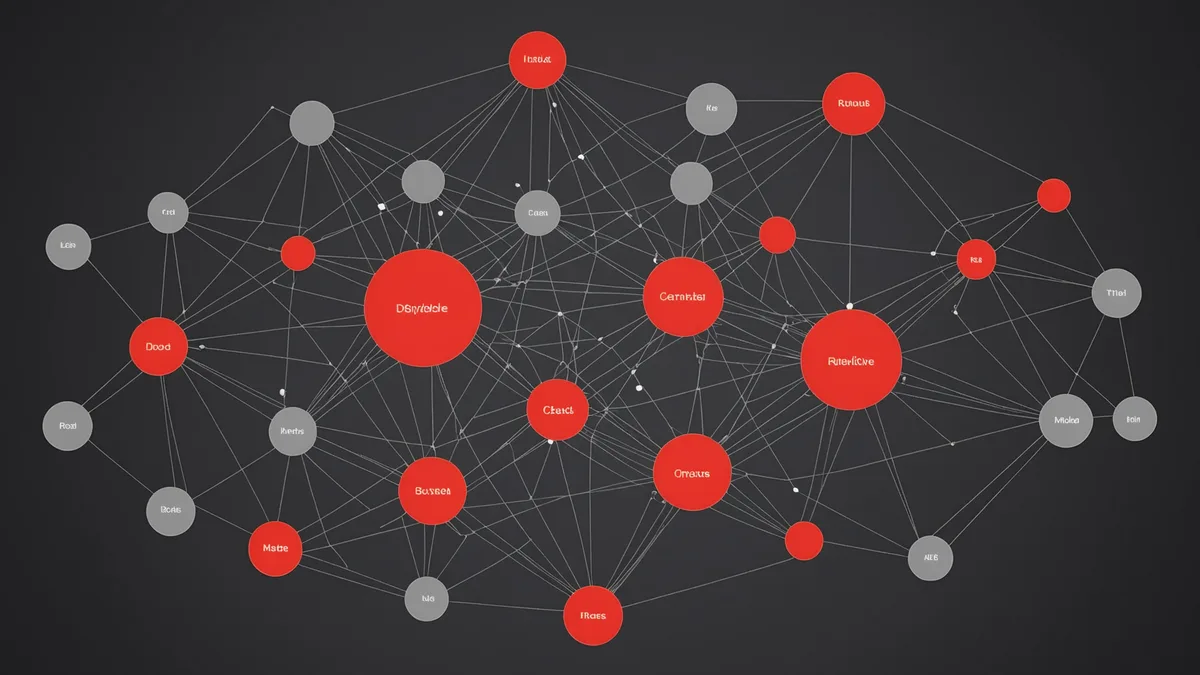
Consider an internal authentication service that issues tokens consumed by 12 downstream microservices, three of which are Tier-1 customer-facing. By function, the auth service might rate as Tier-2. By blast radius, it's effectively Tier-1: a compromise that lets an attacker forge or steal tokens affects not just the auth service but every downstream service trusting those tokens. The blast radius view bumps its criticality tier and therefore the urgency of any vulnerability finding against it.
Building blast radius into your criticality model requires a dependency map — either from your service topology documentation, from a runtime traffic analysis tool, or from a manually curated dependency graph. In smaller environments, you can build this in a few hours by querying which services call which APIs. In larger environments, it requires either automated service mesh telemetry or a concerted mapping exercise.
For the Vendrsec scoring model, blast radius is encoded as a separate attribute — "dependency count" — that contributes to the final criticality score independent of the function-based tier. An asset with no dependent services scores its base tier weight. An asset with 8+ dependent services of mixed tiers gets an additional multiplier that can push it up by roughly half a tier.
Data classification as a criticality input
Separate from function and blast radius, the type of data an asset handles directly affects the severity of a compromise. An asset storing hashed passwords is different from one storing plaintext PII. An asset with read-only access to customer records is different from one with read-write access and no audit logging.
Data classification labels — typically maintained by your data governance or compliance program — can be imported as a criticality input. In the absence of a formal data classification program (common in early-stage tech companies), a practical substitute is compliance scope membership: assets in your PCI-DSS cardholder data environment (CDE) or in your SOC 2 audit scope get elevated criticality by default, because regulatory frameworks exist precisely because those asset categories carry high impact on compromise.
We're not saying you need a complete data governance program before building a criticality model — that's an 18-month project. A practical starting point is three categories: assets that handle regulated data (PCI, HIPAA, GDPR in scope), assets that handle internal-only data, and assets that handle no persistent data at all. Even this rough classification significantly improves prioritization accuracy over a flat inventory.
Building the model: a practical approach for growing teams
Consider a scenario that mirrors what we see in practice. A security-focused B2B infrastructure company with about 600 managed assets: 120 cloud instances across AWS, 80 containerized services, and the remainder a mix of managed services, development VMs, and network devices. The security team — two people — is starting from a Tenable.io export with no criticality tags.
A practical first pass: pull the asset list and ask two questions for each asset group (not each individual asset — group by service or function). First: if this was completely offline for 24 hours, does customer-facing functionality break? Second: does this asset handle, store, or transmit data that a breach notification lawyer would care about? Yes to the first question pushes into Tier 1 or 2. Yes to the second adds the data classification weight.
For 600 assets, a security engineer who knows the infrastructure well can do this classification pass in about 4 hours. The output is imperfect — there will be assets you're not sure about — but imperfect criticality context is dramatically better than no criticality context when it comes to prioritization. You can refine the model iteratively; you just need a starting state that reflects what you know about your infrastructure.
The Vendrsec model accepts this kind of initial classification through structured asset tags in the ingestion layer. Tags propagate through the scoring model on the first scan run, immediately improving the prioritization output over a CVSS-sorted baseline.
Keeping the model current
Asset inventories are never static. New services get deployed. Old services get decommissioned but linger in scanner scope. Business function changes — an asset that used to be internal tooling becomes customer-facing when the product ships. A microservice that was isolated gets promoted to handle authentication tokens after a refactor.
The failure mode we see most often: a criticality model that was accurately built at one point in time and then never updated as infrastructure evolved. Six months later, the model is still classifying a decommissioned legacy server as Tier-1 because it used to serve production traffic. The scanner finds vulnerabilities on it. Those vulnerabilities get emergency treatment based on stale criticality data.
Infrastructure change events — new service deployments, data classification changes, network topology changes — should trigger a criticality review for affected assets. This doesn't mean rebuilding the model from scratch; it means having a clear owner for the model (usually the person who built it) and a process for surfacing infrastructure changes to that owner. In practice, this is a 30-minute review after each major infrastructure change, not a continuous burden.
Asset criticality is foundational infrastructure for a functioning vulnerability prioritization program. Without it, you're sorting by scanner severity and hoping the findings that matter most happen to be at the top.