The Conceptual Gap Between Theory and Practice
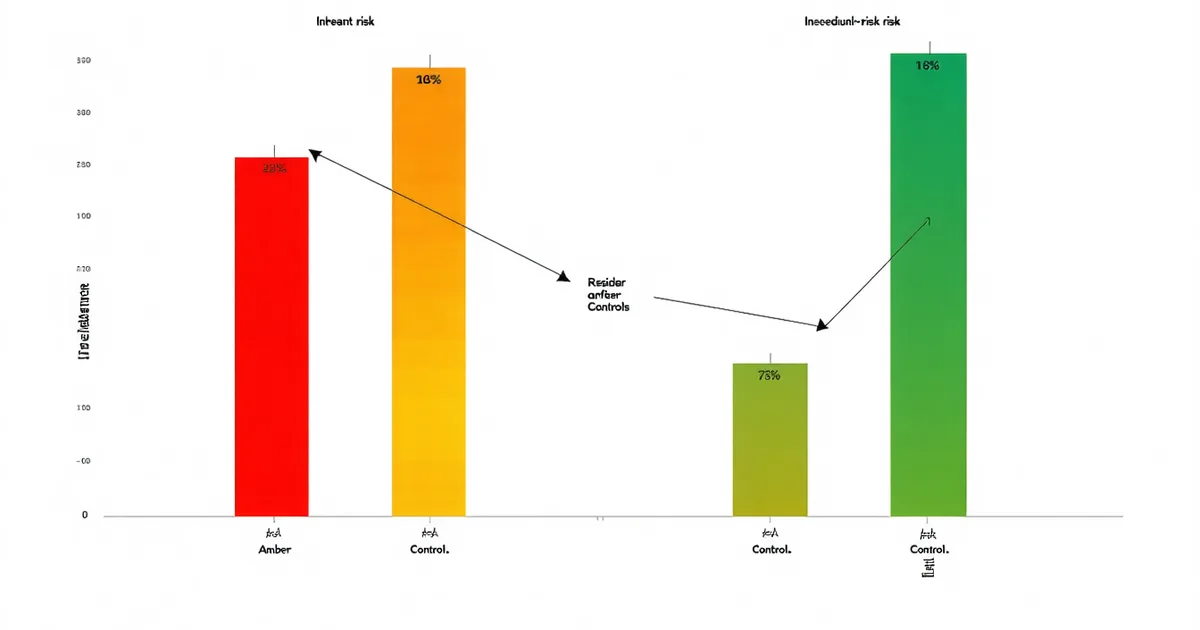
Inherent risk and residual risk are foundational concepts in information security risk management, and most vendor risk practitioners can define them accurately: inherent risk is the exposure before controls; residual risk is what remains after controls are applied. The distinction is clean on paper. In practice, vendor risk programs struggle with it in ways that erode the usefulness of both scores.
The most common failure mode is programs that calculate inherent risk at intake and never update residual risk as evidence comes in. The inherent risk score sits in the system as a permanent fixture; the residual score is either absent or updated only when a full re-assessment is triggered. Between assessments, the risk posture of the vendor portfolio is represented by inherent risk scores that say nothing about control effectiveness — and residual risk scores that are increasingly stale with each passing month.
A second failure mode is programs that conflate the two scores by treating questionnaire responses as a direct measure of inherent risk. If a vendor scores low on an access control questionnaire, that is a finding about their control implementation — a residual risk input — not a statement about the inherent exposure of the relationship. Mixing these up produces scoring outputs that cannot be interpreted consistently.
What Inherent Risk Is and Is Not
Inherent risk in a vendor context is a measure of the potential impact of a vendor relationship or vendor failure, absent any controls on either side. The key inputs are relationship attributes, not vendor attributes:
- Data sensitivity: What classification of data does the vendor access, process, store, or transmit? PII, financial data, health information, and intellectual property each carry different regulatory and business risk profiles.
- Access depth: Does the vendor have read-only access to data exports, or administrative access to production systems? Is their access scoped to a specific function or broad?
- Service criticality: How dependent is your organization on the vendor's service? What is the business impact of a 24-hour outage? A 72-hour outage?
- Substitutability: How quickly could you switch to an alternative if this vendor failed or was compromised? Vendors providing commodity services are easier to substitute; vendors providing deeply integrated or specialized services carry higher inherent concentration risk.
- Geographic and regulatory exposure: Does the vendor operate in jurisdictions with different data protection regimes? Does cross-border data transfer apply?
Notice that none of these inputs depend on what security controls the vendor has in place. A vendor with a mature security program, full SOC 2 Type II coverage, and annual penetration testing still has a high inherent risk profile if they have administrative access to your production identity infrastructure and there is no viable short-term substitute. Inherent risk is a property of the relationship structure, not the vendor's security maturity.
What Residual Risk Requires to Be Meaningful
Residual risk is only meaningful when three conditions are met: the inherent risk is well-defined, the control evidence is current, and the control effectiveness assessment is calibrated to the inherent risk profile rather than applied uniformly.
Condition 1: Current evidence
The single biggest threat to residual risk score validity is stale evidence. A control effectiveness assessment based on a questionnaire completed fourteen months ago reflects what the vendor's controls looked like fourteen months ago. It says nothing about whether MFA is still enforced on the same systems, whether the SOC 2 report has been renewed, whether the pen test findings from last year have been remediated, or whether staff turnover has affected the security team responsible for those controls.
Residual risk scores should carry a staleness indicator — a measure of how old the evidence inputs are and how much confidence degradation has occurred since the last assessment. A residual risk score with all inputs from the last 90 days carries high confidence; the same score with inputs from 18 months ago should be treated as provisional and flagged for re-assessment.
Condition 2: Evidence over self-attestation
Self-attestation inflates control effectiveness scores. When a vendor marks "yes" to questionnaire items without attaching supporting evidence, there is no basis for distinguishing a vendor with strong controls from a vendor who answered optimistically. Residual risk scores derived from unevidenced self-attestation are not comparable across vendors and should not be used for prioritization decisions.
The practical implication is that evidence collection must be a first-class part of the assessment workflow — not an optional enhancement. For each questionnaire domain, define what evidence is required to validate a positive response. For access control: an IAM policy document, a screenshot or report showing MFA enforcement, an access review log. For incident response: the IRP document, evidence of a tabletop exercise within the last 12 months. The residual score for each domain should reflect whether that evidence was received and reviewed, not just whether the question was answered affirmatively.
Condition 3: Control effectiveness calibrated to inherent risk profile
A uniform control effectiveness scale applied across all vendors regardless of their inherent risk profile produces distorted residual scores. For a Tier 3 vendor with low inherent risk, partial control implementation in the incident response domain may be acceptable — the business impact of a slow response from that vendor is limited. For a Tier 1 critical vendor with high inherent risk in the same domain, the same partial implementation is a material finding that significantly elevates residual risk.
The residual risk calculation should weight control effectiveness by how much that control matters given the specific inherent risk profile of the relationship. Access management controls carry higher weight for vendors with broad system access than for vendors with data-export-only access. Business continuity and availability controls carry higher weight for vendors with high service criticality than for vendors providing non-critical supplemental services.
Keeping Both Scores Current Without Doubling Review Workload
The practical challenge is that maintaining current inherent and residual scores for a portfolio of 50-100 active vendors is a significant operational burden if each score requires a full re-assessment cycle to update. The answer is differential update triggers rather than uniform re-assessment cadence.
Inherent risk scores should be updated when the relationship structure changes: new data processing activities, expanded system access, change in service criticality due to business decisions, or change in the vendor's regulatory environment. These changes are events — they can be flagged by business owners or procurement when they occur. Inherent risk does not drift between events; it changes when the relationship changes.
Residual risk scores should be updated on a cadence calibrated to the inherent risk tier (quarterly for Tier 1, semi-annual for Tier 2, annual for Tier 3), supplemented by event-triggered updates when specific changes occur: SOC 2 report renewal, reported security incidents, significant infrastructure changes notified by the vendor. High-confidence evidence refreshes — a new SOC 2 Type II report, a renewed ISO 27001 certificate — can update specific domain residual scores without requiring a full questionnaire re-assessment.
The Scoring Model Dependency
The inherent vs. residual distinction also depends on which scoring model your program uses. As covered in our comparison of vendor risk scoring models, composite scoring blends multiple signal types — some of which are better indicators of inherent exposure (external security ratings, known breach history) and some of which are better indicators of residual risk (questionnaire-derived control effectiveness, certification status). Understanding which signals feed which score component is necessary for interpreting composite scores correctly.
Programs that track both inherent and residual risk separately — and maintain the separation clearly in their reporting — are better positioned for governance conversations with audit committees and regulators. The question "are your third-party risks being managed?" is most usefully answered with: here is our inherent exposure profile, here is our residual risk posture after controls, here is where the largest gaps between the two exist, and here is what we are doing about them. That answer requires both scores, maintained separately, with current evidence.